A Name-First Basis to Knowing Puddlepond

Welcome to Puddlepond! Puddlepond can be roughly divided into three regions, the fields, the panhandle, and the woods. This is a little confusing, as the fields aren’t entirely contiguous, and the woods certainly aren’t, but I’m more of a practical person than mathematical. The fields themselves have largely been devoted to the horses, while the woods have been claimed by the resident trailblazing bog witch. The panhandle is a very functional part of the property given its proximity to the house, and I consider there to be a bit overlap with the nearest fields. The farm pond of Puddlepond itself may geographically belong to the panhandle, but in all aspects it stands alone. A seasonal stream sourced from neighboring properties and Puddlepond winds through all of this, and since I couldn’t find an official name for this fickle flow, I decided to name it Beukenbeek in tribute to the local beech groves which lent their name to the Beukendaal neighborhood.
I’m not going to pretend that I’m good at naming places, but I do find it very helpful to have a shared vocabulary for discussing our plans, present, and future. My influences seem to be a mix of fantasy, children’s literature, and the long-held tradition of naming things very literally. Others have certainly pitched in with their suggestions and actions, but my need for clear communication means I’ve bullied my names into broad use. Let me give you a tour of the property though these names, and I hope I can help you feel more at home at Puddlepond.

We’ll start with the panhandle, where the house sits, and Puddlepond meets the road. I’ve tried to impose fun names on the barn and house, but since we only have one of each, I’ve failed. The yards aren’t the focus of our lives here, so front, side, and back yard are also boringly sufficient. We do have a few gardens, and the panhandle is home to the Botanical Garden, a variably-maintained collection of flowers left from the previous owners. Up on the hill that compromises the backyard is a second garden, the Pyrrhic Victory Garden. With our efforts still concentrated in the back acreage, the raised beds of the Pyrrhic Victory Garden may produce the occasional herbs and veggies, but at the cost of a great loss of yield. We were gifted four established fruit trees by the toils of the previous owners: a sour cherry tree on its last legs at the end of the Pyrrhic Victory Garden, and three pear trees adjacent to the barn. These three trees make up a section of yard we fenced off as a chicken run, which I refer to as Pearly-An Orchard. I think this Orchard is soon to be reduced to the two healthiest pear trees; I’m not sure if there’s hope for transplanting the crowded and stunned middle pear, but it isn’t happy where it is either.
Behind the barn is where things start to feel more farm-y. We have the Barn Paddock, a great demonstration of my naming prowess, as it is the horse paddock attached to the barn. The temptation to rename it “Battleground Paddock” has been strong at times. After a winter of hosting horses, it certainly looks like a muddy and pocked battlefield, so in spring we have to battle the ground itself back into a respectable shape. This is the most convenient paddock we have, but in time we plan to utilize it less and preserve our sanity more. Beyond a drainage ditch optimistically named Walnut Creek for its arboreal destination lies a thin strip of trees, primarily evergreens, not referred to much at all. I’d like to call it Goodberry Glade after the wild grapes and raspberries growing there, but again, we just don’t call it much of anything. Behind that wind break is Pond Paddock, separated from Puddlepond by a flat chunk of grass we use to stage vehicles, horses, dogs, and children for later use. Pond Paddock’s location on the windward side of Goodberry Glade exposes it to much more weather, making it less useful in winter and consequently less devastated by horse hooves.
On the south side of the road is Firefly Field, which very much lives up to its name in June and early July. As of yet, this field isn’t overly developed; we keep it clear for warm-up rides, our compost pile is located at its farthest corner, and recently it has been home to the Chicken Trailer and surrounding electric net fence. Firefly is a strange microcosm, having been used for hay but never converted to corn, while being bordered by the wet depression referred to as Firefly Fen. As a quick side note, the Fen is both an effective barrier to the horse fields beyond, and apparently misidentified, as our acidic soil should creates swamps rather than fens. The moist soil of the Fen extends into the west edge of Firefly Field, creating a borderland of ferns and reeds, while a rogue patch of mugwort has claimed a large chunk of the high ground. Between and astride these microclimates are patches of roses and milkweed. The roses actually more annoying than pretty, but we would feel guilty removing them. Conversely, we do our best to maintain a healthy population of milkweed, which pays off with a healthy population of migrating butterflies.
Continue down the road past Puddlepond and you’ll arrive at the Ceremony Field. I had initially envisioned this, the smallest of the cornfields, becoming an orchard, but it turns out that fruit trees take a lot of work and money to establish. In the meantime, we’ve had our own wedding here, converted the field to a meandering wildflower meadow, and toyed at establishing a smaller Piddlepond in a wet depression behind the ceremony clearing itself. A major project in itself, the Ceremony Field will continue to accumulate new trees (both for flowers and fruit) and rocks farmed from our other fields to protect a growing rock garden.
The road itself takes a right-angled left-handed turn down a slight slope to the larger fields, since continuing straight ahead would leave you hopping across a branch of the Beukenbeek fed by the overflow from Puddlepond’s water-level controlling weir. Beyond this brook lie one of three primary woodlots, the Seven-Acre Woods, home to our largest beech grove, many pine trees, and the winding main branch of the Beukenbeek. A relatively rough expanse of hillside, the terrain of the Seven-Acre Woods is excellent for hiking, but not as easy to clear for horse trails as the other woodlots. We have great aspirations and equal challenges in Seven-Acre, but even now it the meanders cut into the hillside are beautiful throughout the year, watched over by the large Old Oak atop a bluff.
Let’s go back to that turn in the road lest we get ahead of ourselves and really confuse things. The first field was the first place we encountered our local turkey flock, and so Turkey Hill named itself. Since this is the first of the large cultivated fields, Turkey Hill has been and continues to be a lot of different things for us. A set of raised beds line the north edge, forming an as-yet-to-be-named flower and vegetable garden. A little less than half the field has been fenced off to form a small horse pasture, especially useful for severe weather if we’re concerned about access to the other fields beyond. A graciously-loaned set of steel tube fence panels forms a round pen for exercising and jailing uppity ponies, with a large portion of the remaining field cleared as our primary riding arena. In the past we’ve parked the Chicken Trailer here, grown flowers and veggies as row crops, and gone sledding down its slope in winter.
Beukenbeek continues to shape the property here, as it passes between the Seven-Acre Wood and Turkey Hill, then flows (usually, more on that later) through the ominously-named Stormwash Culvert and through our smallest woodlots, Pine Hollow. Pine Hollow is mostly pine on the high ground, but is also home to our most concentrated population of sugar maples, and is bordered by a small beech wood. The Hollow continues behind Firefly Field and Fen, with nascent trails connecting them up to Turkey Hill and Creekcut Corner beyond.
Passing over Stormwash Culvert is usually a simple affair, but when storms overload Beukenbeek’s banks, the culvert itself can’t handle the load, and some of the flow washes over the top of the road, filling our hearts with dread at the erosion damage we’ll eventually need to repair. The road continues up a tree-lined thoroughfare known as Porcupine Pass. This straight, hilly lane is named for an unfortunate incident that occurred between a friend’s dog and one of the forest’s peevishly prickly denizens. Continuing uphill here, we would pass Seven-Acre on our right, but since we already detoured there once, it is at the base of Porcupine Pass that we’ll depart the road and start exploring the remaining fields.
The first field we come to is Creekcut Corner, whose eastern edge descends into The Swamp at the corner of our property, fed by a bend in Beukenbeek that gives this field its name and shape. Creekcut’s location at the bottom of the hill seems to have created propensity for rogue rivulets forming deceptively steep washes on either edge. The soil is fairly good, but the extra moisture makes it prime territory for horsetail, sedge, and reed canarygrass. I confess that I haven’t spent much effort working on Creekcut yet, but the horses generally don’t mind too much when we have them here during out rotation. We’ve been able to enclose more area here than in Turkey Hill, plus the slope gives them a little extra exercise.
Uphill from Creekcut is Horseshoe Hill, currently the largest and “healthiest” of our pastures. Perhaps not as obviously named, Horseshoe was a milestone pasture for use, as well as being the center of the horseshoe-shaped set of fields. This is yet another battleground, as I have dedicated myself to combat the junk growing here in hopes of establishing better pasture with minimally-invasive methods. The various species already established here haven’t quite gotten the message yet, but a mobile hay ring and equine grazing are valuable allies in knocking back some of the undesirables. While efforts to dormant-seed spring rye yielded marginal results due to an unreasonably warm winter, I maintain hope as this fall brought with it a rich carpet of clover covering the majority of the Horseshoe Hill pasture.
A pair of fields finish our tour of Puddlepond’s open spaces. Being atop our hill, distant, and somewhat rolling, we referred to these as the Upper and Lower Steppes, though perhaps North and South Steppes would’ve been more accurate. The last corn harvest in the Upper Steppes largely failed, but it maintains a healthy population of tall grass, with the reed grasses outcompeting the sedges and horsetail of the lower fields. This high cover makes the Upper Steppes a favorite of local deer, but in the near future we’ll need to tap into its potential as pasture. The soil in the Lower Steppes seems healthy with a large variety of meadowland plants spreading across the field. Shade from the treeline helps limit evaporative loss and runoff from the woods inundate the northern edge of the field, keeping it from drying out as completely as some of the other pastures. Due to this promise, I made the decision to designate Lower Steppes for a complete haircut via rotary cutter, and followed that up with my first attempt at implementing a turning plow. We’ll have to see how well I can capitalize on this work in spring, but my hopes are high.
Above the Steppes, at the back of the property, are the Lost Woods. Much flatter terrain than Seven-Acre and Pine Hollow, broken only by one always-soggy-but-rarely-flowing drainage wash, the Lost Woods appear to have gone through a few phases in the past. Stone walls hint at a past as a clearing, while a few existing roads appear to be remnants of logging operations. Because of this history, most of the trees are of similar age and relatively evenly spaced. This has made the Lost Woods the best location for an initial trail network, with gentle riding and learning curves. Originally named for their distance from the house, Lost is increasingly becoming a misnomer as we spend more time there and create an easily-navigable trail system.
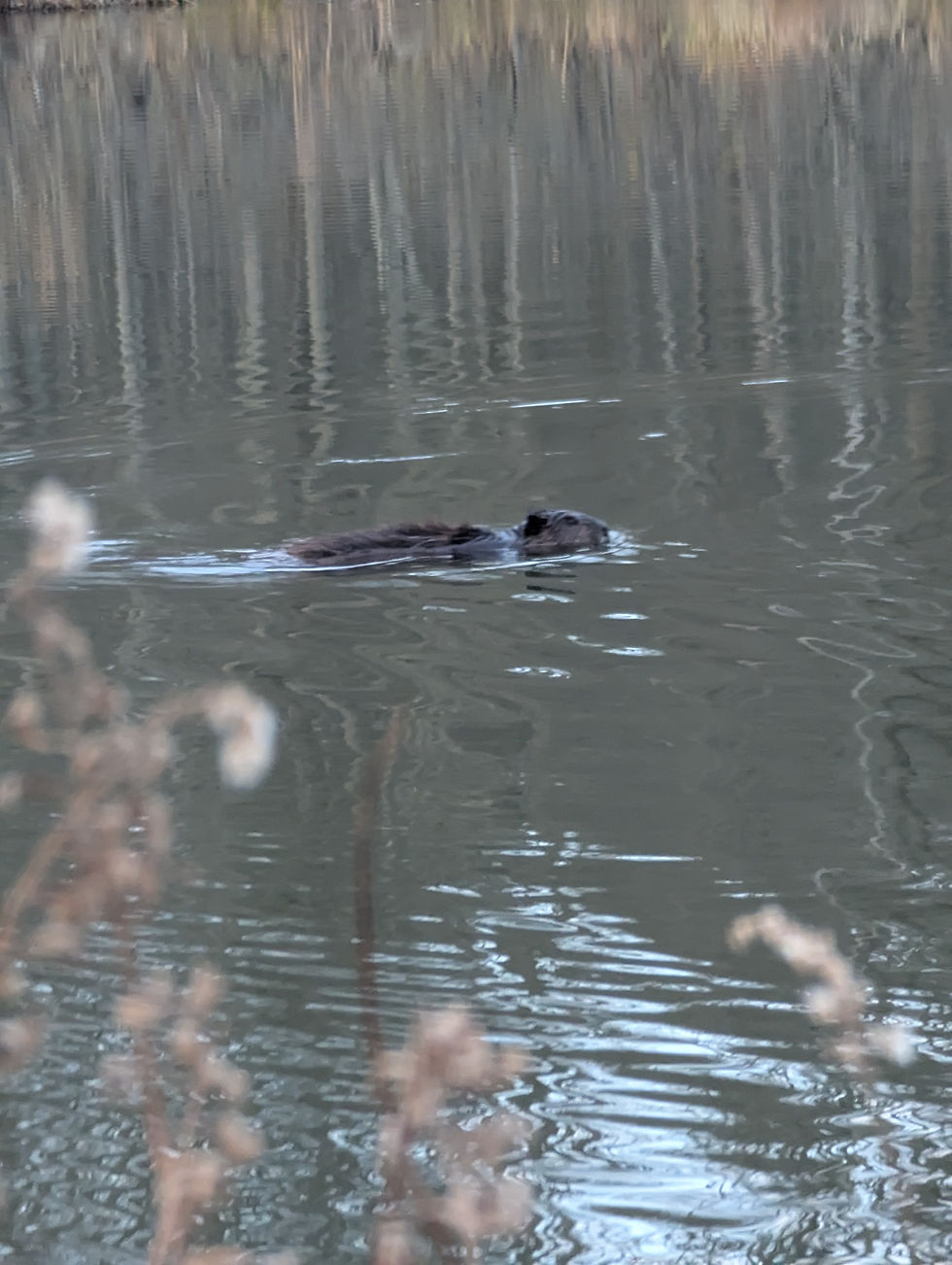
On our way back to the house, we’ll finally stop to admire Puddlepond, the namesake of the property. Only about two-thirds of an acre in surface size, Puddlepond dominates the character of the place. Stocked with a variety of fish, home to turtles, the occasional muskrat, and currently a beaver, Puddlepond is rich with life. It attracts great blue herons, osprey, and young bald eagles. Even the more mundane frogs, insects, and kingfishers the frequent the pond can be endlessly fascinating on a summer afternoon. The pond freezes over in winter, creating a convenient shortcut for terrestrial animals, who weave their travel tales into a web of wildlife trails across the snow and ice. In spring and fall, the vibrant colors of change are reflected by its waters, with the clouds above telling of impending April showers and September thunder bursts. A small spit of land allows you to walk out into the deeper end of the pond, surrounding yourself on three sides with its waters, though if you take a step too far you’ll discover that Puddlepond isn’t only around you, but beneath you as well, and probably also in your shoes. And really, that is something worth taking away. Once you dip your feet in Puddlepond, it seeps into you and marks your footsteps even as you walk away.


Comments